The Invitation Your Body Refused
When Somatic Resistance Reveals What the Mind Has Not Yet Admitted

Some invitations are not invitations. They look correct from the outside. They are polite, expected, and socially reasonable. Not only that, but they arrive through family, marriage, partnership, or obligation. Everyone assumes the answer should be a “yes”. But the body knows the difference between being included and being recognised.
That difference matters a lot.
For many high-functioning adults, burnout does not begin with workload. It begins with repeatedly entering rooms, roles, relationships, and decisions where the body has already registered resistance. They say “yes” because it is easier, then the body begins to speak.
Back pain.
Tension.
Fatigue.
A tight stomach.
A heaviness that appears before the event, the meeting, the journey, or the decision.
Most people treat this as an inconvenience. In Human Design with Gloria, it is treated as data. Not drama or weakness and not over-sensitivity, but data.
The False Invitation
A man was expected to attend a wedding anniversary in another part of Germany. The event belonged to his wife’s family. His wife, a Manifesting Generator by design, wanted him to accompany her. The date had been arranged months in advance. A gift had been prepared. From the outside, the situation appeared simple. He had not given a firm “yes” because he was not sure. He was a Projector who had been experimenting with his design for some time, long enough to understand that the body often speaks before the mind has evidence.
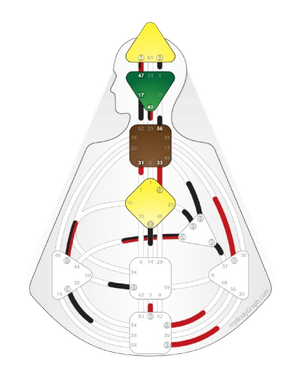
As the event approached, his body began to feel uncomfortable. The main signal was lower back pain (in Human Design, this would be the Sacral Centre). At first, the mind explained it away.
“Maybe it was a planetary transit.”
“It could be a simple physical strain.”
“Perhaps it was something he had eaten”
“Maybe it was ordinary tension from sitting or lying in the wrong position.”
The mind is skilled at delaying the truth with acceptable explanations, but the closer the event came, the worse the pain became. Eventually, he looked at the only major decision in front of him: attending the anniversary.
He decided not to go. No performance or long justification. He did not attempt to convince anyone. Just a clear “no”.
The Body Knew Before The Facts Arrived
When his wife informed her family that he would not attend, the truth surfaced. The hosts had not actually invited him. They explained that they had not included him because he did not usually attend family gatherings, and they did not want him there.
His wife had invited him because she wanted his company, but the event itself had not recognised him. For a Projector, this is not a minor social detail. It is mechanical.
A Projector is not designed to force entry into spaces where recognition is absent. Without recognition and correct invitation, the Projector often meets resistance, depletion, and bitterness.
In this case, the body registered the absence of recognition before the social facts were spoken aloud. The mind did not know. The body did.
What Society Would Have Called It
Society would likely have given him a simpler label.
Difficult.
Too sensitive.
Unsociable.
Rigid.
Uncooperative.
Overreacting.
This is where many people lose authority. They trust the social interpretation more than the body’s signal. So, they override it.
They go anyway. Smile or perform anyway. They call the pain stress and push through. Well, medication does the rest. Then they wonder why they are exhausted.
This story is Projector-specific, but the principle is wider: the body often registers misalignment before the mind has proof. The problem is that most people have been trained or conditioned to distrust that registration.
Somatic Resistance Is Not Always Psychological
Much of modern advice reduces these moments to psychology. They say:
“Set boundaries.”
“Practise self-care.”
“Manage your anxiety.”
“Communicate better.”
Sometimes those things are useful, but sometimes they are too shallow. The issue is not poor boundary language. The issue is incorrect energetic placement.
The body may be objecting to a room, role, relationship, obligation, or decision that does not recognise the person correctly. This is where the Human Design with Gloria approach becomes precise. The question is not only:
“How do I cope with this event?”
The deeper question is:
“Was my system ever correctly recognised and invited into this space?”
That is a different level of inquiry.
The Cost of “Performing” Belonging
Many high-functioning adults are skilled at “performing” belonging to a network, community or family. They know how to behave, how to be polite or how to enter rooms where they are tolerated rather than recognised. They know how to maintain social order while abandoning the body’s truth.
This is expensive.
Especially for those recovering from burnout or years of conditioning. The old pattern may have survived by adapting. The aligned system may no longer be willing to pay that price.
This can confuse family, partners, friends, and professional circles. They may say:
“You’ve changed.”
Often, they are correct, but not in the way they think. The person has not become difficult. The person has stopped using life-force to uphold a false version of themselves.
That is not rebellion; it is recovery of authority.
Alignment Does Not Mean a Perfect Life
Let us be precise. Living according to your design does not guarantee a smooth life.
It does not mean family dynamics become easy. It does not mean people understand you. It does not mean every “no” is accepted gracefully.
Alignment is not fantasy. Alignment means the body is no longer forced to fund unnecessary resistance.
That is the difference.
In this story, the man’s “no” did not create a sentimental resolution. It revealed the truth. His wife chose not to attend because she had wanted his company, and the family had made their position clear. The gift was still sent. The event continued without them.
Life remained life, but an unnecessary battle was avoided.
He did not spend precious energy entering a room where he was already rejected. That is what alignment protects. Not comfort, but vital, energetic resources.
The Invitation That Matters
The most important invitation is not always the one on the calendar. It is the one your system recognises as correct.
Some invitations are social.
Some are polite and strategic.
Some are inherited obligations dressed as inclusion.
And some are true.
The body knows the difference before the mind can prove it. The question is whether you are willing to stop overriding the evidence.
In Human Design with Gloria, the body is not a decoration around the mind. The body is the system that must live out the decision. The mind can explain, justify, and negotiate, but the body pays.
For a Projector, recognition matters. For other designs, the mechanics differ. The point is not to copy the Projector’s process. The point is to understand that each person has a specific way their system registers correctness.
That precision is not available through generic advice. It requires a different kind of audit.
What is the signal?
What is the hidden mechanism?
Where has the mind taken authority?
What is the body refusing to fund?
Those questions are not casual. They are structural.
If this story feels uncomfortably familiar, the next step is not another boundary script. It is a better orientation.
Explore the Digital Collection privately for audio guidance on decision-making, pressure, and the body’s signals beneath burnout.