
When The Body Speaks

What if your body isn’t betraying you, but protecting you?
What if the pain you feel is not a problem to eliminate, but a message asking to be heard?
Most people are taught to distrust their bodies.
We are trained to override sensation with logic, obligation, and cultural expectation. We push through fatigue. We rationalise discomfort. We explain away pain. And when the body insists, we label it as malfunctioning.
But the body is not careless.
It does not shout without reason.
The cost of overriding the body
In modern life, listening to the body is often framed as indulgent or impractical. There is always something more urgent to do. Someone else to accommodate. A deadline to meet. A role to perform.
So we say yes when the body tightens.
We stay when the chest constricts.
We push forward when the stomach turns.
At first, the body speaks quietly, through subtle tension, shallow breath, restlessness, or unease. These signals are easy to ignore, especially if you’ve learned to live from the mind.
Over time, what is ignored becomes louder.
Fatigue turns into exhaustion. Unease turns into anxiety. Tension turns into pain.
This is not punishment, it is communication.
Pain as information, not failure
Pain is often treated as an error state, something that has gone wrong and must be corrected immediately. While medical attention is sometimes necessary, not all pain is pathological. Much of it is contextual.
The body responds to environments, relationships, expectations, and pressure long before the mind catches up.
A headache may occur after a conversation you endured rather than chose to have.
Back pain may follow months of carrying responsibility that was never yours.
Digestive issues may mirror situations you have been unable to “stomach.”
None of this is mystical. It is physiological intelligence.
The nervous system continuously records safety and threat. When something is misaligned, the body signals it, often before you can articulate why.
Why the mind resists listening
Listening to the body requires presence. Presence requires slowing down, and slowing down is uncomfortable in a culture that rewards speed, productivity, and self-sacrifice.
The mind prefers explanations that keep life moving forward unchanged. It will justify discomfort if it means avoiding conflict, disappointment, or uncertainty, but the body does not negotiate concepts. It communicates in sensation, and sensation cannot be reasoned away.
The first signal is the kindest one
Most people don’t ignore their bodies once. They ignore it repeatedly. The first signal is often gentle:
a sense of heaviness
a subtle withdrawal of energy
a quiet resistance
When that signal is respected, the body settles.
When it is overridden, the body escalates, not out of anger, but necessity.
Listening earlier is not a weakness; it is a natural efficiency.
Re-learning how to listen
Listening to the body does not mean analysing every sensation or withdrawing from life. It means restoring a relationship that may have been neglected for years.
Start simply.
Notice:
Where does your body relax?
Where does it contract?
When does your energy naturally drop?
When does it return?
These observations are not instructions. They are information. The body does not demand dramatic change. It asks for accuracy.
When the body becomes an ally again
When you stop treating the body as an obstacle, something shifts.
You begin to recognise:
which commitments drain you
which environments require recovery
which decisions create quiet relief rather than tension
The body becomes a compass rather than a battleground. This doesn’t make life effortless. It makes it honest.
A simpler way forward
For those who have spent years overriding themselves, learning to listen again can feel unfamiliar. Sometimes it helps to be guided, not to be fixed, but to be oriented.
There are quiet, contained ways to explore this relationship through reflection and structured listening, without turning it into another performance or project.
If this resonates, there is a private audio in the Digital Collection that explores how bodily signals emerge, why they are often ignored, and how to respond to them without pressure or judgment.
Closing reflection
You don’t need to force awareness.
You don’t need to interpret everything perfectly.
You only need to pause long enough to notice:
What is your body already telling you, and how long has it been saying it?


Preview
Every environment seemed to ask him to become someone different. With one group he was confident. With another, quiet. Somewhere else he became ambitious, agreeable, or cautious. The changes were so natural that he rarely questioned them. Until one day he wondered:
Who am I?
The Man Who Kept Changing Colour is a Human Design Story Experience exploring one of life's deepest questions: identity.
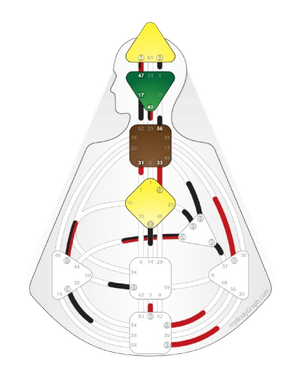
Rather than teaching through diagrams or technical language, this experience follows one man's search for a place where he no longer has to adjust who he is to belong. Along the way, you'll discover why identity can feel unwavering for some people, while others seem to change with every environment, relationship, or stage of life.
At the heart of the experience is the G Centre in Human Design, a centre associated with identity, direction, love, and the influence of place. Through story and teaching, you'll gain a practical understanding of how these themes may show up in everyday life.
Included inside this experience:
A 20:19-minute audio story
A premium visual companion PDF
Access to 75 minutes of Living Your Design G Centre teaching video for the deeper mechanics
Whether you're encountering Human Design for the first time or looking at it from a fresh perspective, this experience invites you to consider a question that many people quietly ask:
Are you changing because you've grown... or because you've never been in the right environment to simply be yourself?
This is an educational Human Design experience. It is designed to introduce the principles of the G Centre through story, helping you observe your own patterns with curiosity, clarity, and greater self-awareness.
The story is narrated using an authorised digital model of Gloria’s voice. All teaching and creative direction are Gloria’s own.