The Wolf, The Mirror, And The Hard Work Of Staying Sovereign
Some people are controlled through the emotions they produce. Others are controlled through the emotions they absorb.
A predictable emotional system is easy to read. It is easy to provoke, flatter, shame, and manipulate.
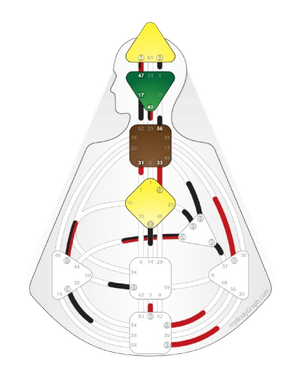
In Human Design, the Emotional Centre reveals an absolute mechanical function within the body: whether emotion moves through a person as a consistent internal wave, or whether their openness amplifies the emotional climate around them.
This is not a lesson in becoming emotionless. It is an audit of emotional pressure and an exposure of the exact point at which another person, the environment, or society takes hold of your decisions.
The Wolf Remained Powerful, But Ryu No Longer Obeyed It
A predictable emotional system is easy to read. It is easy to provoke, flatter, shame, and manipulate.
The Province Of The Iron Mountain
In the ancient, mist-shrouded province of the Iron Mountain, human nature was not studied in books. It was decoded in the forces of the wild. Among those who lived in the valley, two distinct emotional paths moved side by side, entirely invisible to the untrained eye.
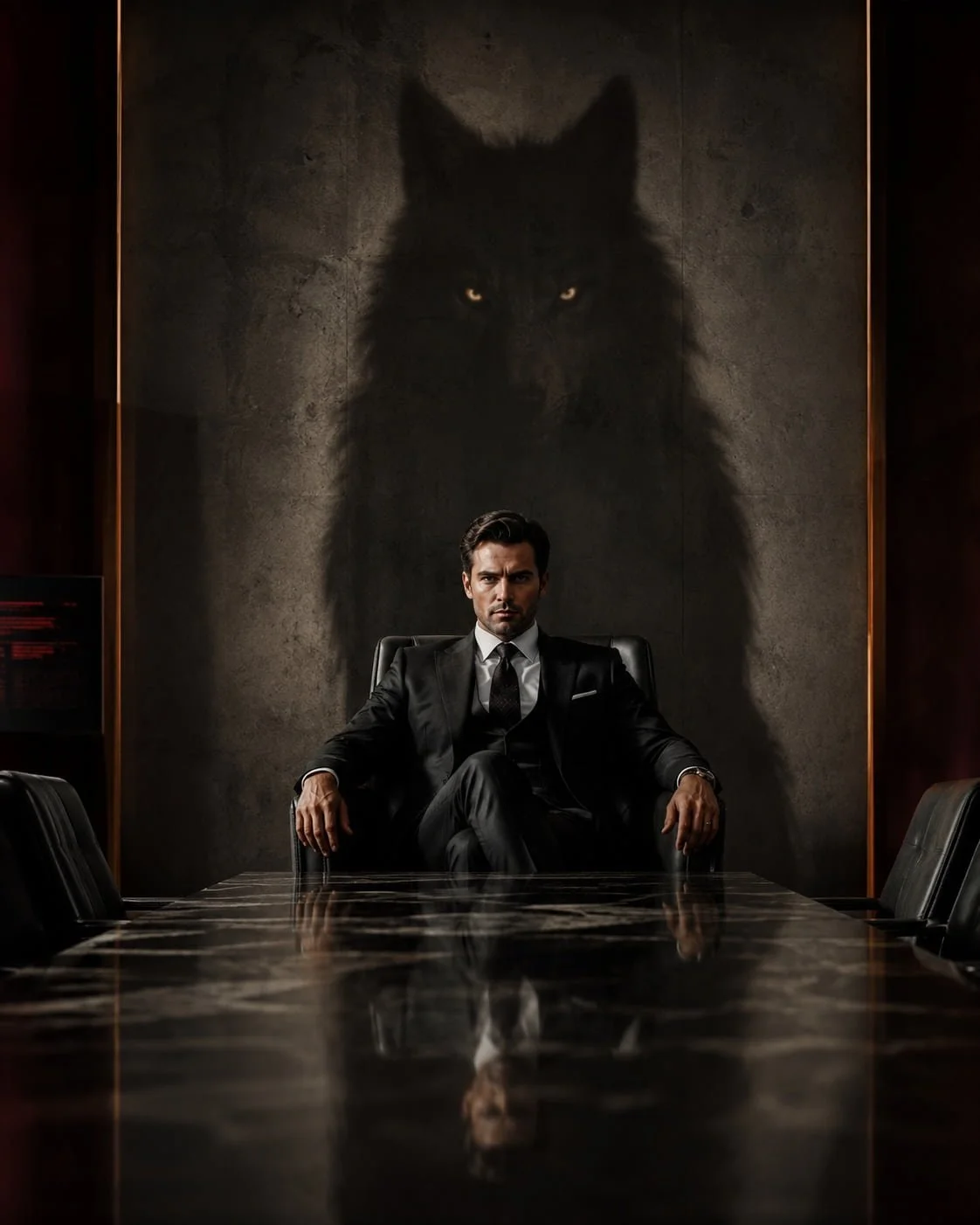
The first path belonged to a young warrior named Ryu. Ryu was born with a Crimson Wolf living within his spirit, a massive, fiery creature of pure emotional energy that rose and fell in powerful, unyielding tides of emotion.
Because Ryu did not understand the structural mechanics of his beast, he lived entirely at its mercy. When the Wolf surged, Ryu surged. When the Wolf sank, Ryu sank with it. On some days, he was carried by fierce joy, pride, hope, and certainty. On others, he was swallowed by sorrow, blame, shame, and suspicion. He believed the Wolf’s growls were the absolute truth. He thought his intensity made him powerful, but he was merely the beast's servant.
The second path belonged to a wandering scholar named Sheng. He carried no wolf of his own. His gift was colder. His mind was sharp, calculated, and detached. He knew exactly how to track the scent of other men's beasts. He was a master of strings.
Sheng studied the animals inside other people. He learned exactly which men could be moved by praise, which women could be bent by guilt, which leaders could be rushed by panic, and which wounded souls would surrender if shame was pressed hard enough. He did not need physical force; he only required access to the exact moment before another person reacted.
Act I: The Leash And The Master
One spring morning, Ryu’s Crimson Wolf was drunk on a sudden surge of pride and wild, fiery joy. Every doubt sounded like weakness. He marched into the village square, boasting of a reckless plan to attack a rival clan’s fortress before nightfall without preparation. He was riding the very peak of his internal crest.
Sheng watched him from the shadows. Instead of arguing with logic, which would have caused the Wolf to bare its teeth, Sheng smiled smoothly. He approached Ryu and methodically fed the Wolf’s vanity.
"Only a god could possess such a fierce vision, Ryu," Sheng whispered. "To wait even a day would be a coward's choice."
That was enough.
Blinded by the beast’s euphoria, before the sun dropped behind the Iron Mountain, Ryu rushed into the valley. He led his men into a disastrous charge that cost them their pride, their weapons, and absolute trust in his command.
Months later, the inevitable crash arrived. The Crimson Wolf crawled into a dark cave, whimpering in a deep valley of shame, guilt, and depression. Ryu sat alone in the dirt of his own home, paralysed by the beast's heavy, suffocating despair. Every memory of the failed charge returned with sharper teeth: the men he had led, the weapons they had lost, and the heavy silence in the village when he passed.
Sheng entered his home quietly this time, changing his posture completely. He stood over Ryu and pressed precisely where the wound was already open. He spoke with cold, cutting authority, throwing Ryu's failures directly in his face.
“A leader who cannot govern himself should not govern men,” Sheng said. “Your instincts are dangerous. Your feelings have already cost this valley enough.”
Because Ryu could not let the Wolf rest, he did not hear strategy; he heard judgment. He failed to recognise the low place as part of his wave; he believed it was the final truth. Sheng’s words hit like stones thrown at a wounded animal. In a desperate panic to make the painful whimpering stop, Ryu surrendered his family’s ancestral sword to Sheng, begging the scholar to make the operational decisions from now on.
Sheng accepted the sword without surprise. He had not conquered Ryu with strength; he had simply waited for the mechanical wave to fall.
Ryu was completely predictable. When his Wolf was hyper, Sheng flattered it into foolishness. When his Wolf was wounded, Sheng terrified it into submission. The Wolf was on Sheng's leash.
Act II: The Wolf Roams Free
Broken and betrayed, Ryu retreated to a secluded monastery high in the snow peaks. There, an old sage looked into his chaotic spirit and saw the chains.
"You think you must either chain the Wolf to protect yourself, or let it go wild to destroy your life," the sage told him. "Both are errors of a blind ego. A chained Wolf is still ruled by fear. An inexperienced Wolf is still ruled by impulse. You must learn to sit with the beast until its roar no longer becomes your command."

Years passed. Ryu did not kill the Wolf, nor did he lock it behind iron bars. Instead, he sat in absolute silence through the storms of fury, grief, guilt, shame, desire, passion, and panic. He mastered the art of watching the energy without becoming it. He realised the strategy of Emotional Authority: intensity is not instruction; it is merely the wave.
The Wolf Remained Powerful, But Ryu No Longer Obeyed It
When Ryu finally returned to the Iron Mountain, a great crisis had struck. The province was under siege. Smoke rose from the southern gates. Villagers ran through the streets carrying children, grain, water, and blades. Fear moved through the province like a second weather.
Within Ryu’s chest, the Crimson Wolf erupted, pacing and roaring with a massive tide of nervousness and urgency. The old force of spontaneity returned: act now, strike now, decide now, or we perish.
Then Sheng appeared, trying to pull the old strings. He pointed at the chaos and shouted,
"Ryu! The clan is falling! You must sign this decree to hand all provincial power to me immediately, or we lose everything!"
The old Ryu would have reacted either by lunging in anger or by surrendering in fear. Either response would have given Sheng his opening. But the New Ryu did something that stunned the scholar. He sat down on a stone bench, closed his eyes, and breathed.
Inside his spirit, the Wolf was lunging against the gates, demanding immediate movement and a relief of internal tension. But Ryu simply watched it with steady, objective awareness, the heat in his chest, the pressure in his hands, the old command to end the tension quickly. He did not put a leash on it. He let the Wolf roar, knowing a roar is just energy moving through the body, not a command to be obeyed.
Sheng panicked, shouting louder, trying to force a reaction:
“Every breath you waste is another life lost!”
But Ryu’s external body remained as still as stone. Because Ryu refused to act while the Wolf was raging, Sheng’s calculations completely collapsed. A manipulator requires an immediate, impulsive reaction to close the trap.
By waiting for the Wolf to settle into a calm, clarity, not in expectation, not in agony, Ryu became completely unpredictable. The Wolf was no longer on Sheng’s leash. It roamed inside Ryu, fierce and unchained, but it no longer dragged him by the throat.
When Ryu finally opened his eyes, the Wolf was no longer pacing or clawing. It was standing silently behind him in the inner dark, its eyes glowing, silent, and waiting. Ryu smiled a subtle smile. He looked at Sheng and said,
"The enemy is at the gates, Sheng, but the mountain does not move for the wind."
Then he turned to the guards:
“We will strike at my command, not a moment sooner."
Sheng stepped back, his hands trembling. The leash was gone. The Wolf was free, yet entirely master of itself.
Act III: The Open Mirror And The Ghost Wolf
In the shadow of the same mountain lived Mei, a woman born with an open and absorbing spirit. She did not carry a permanent beast of her own. Her system was a mirror: clear, receptive, and easily filled by whatever entered her house. For years, Mei was the tragedy of the valley.
Because her spirit was like an open canyon, whenever she passed an angry man in the market, his anger entered her body and grew teeth. If she sat beside a grieving neighbour, sorrow flooded her chest until she could no longer tell whose loss she was carrying. If a room was tense, her skin tightened before anyone spoke. If a person was hopeful and joyous, Mei took that in too, expressing it twice as intensely.
The valley called her unstable. Mei called herself dangerous.
She wore a thick mask of absolute isolation, living on the outskirts of the forest, trying to stay away from humanity so she wouldn't be possessed by their "Ghost Wolves." She thought isolation was protection, but it did not make her wise. It only kept the mirror covered.
The Default State Of An Unaligned Individual Is To Be Manipulated.
This beast belongs to the scholar. I am only the mirror reflecting his rage.
Then Mei began her own inner shadow work. She looked into the openness of her psyche and, over time, she exposed the pattern. She realised a profound truth: The terrifying beasts raging inside me do not belong in my house. They are just guests passing through the mirror.
One afternoon, Sheng came to Mei’s home to demand her winter harvest. When she refused, Sheng unleashed a wave of manufactured, terrifying fury. He slammed his fist on her table, projecting his psychological malice and intimidation directly into the room.
The old Mei would have absorbed his anger, felt her heart shatter, and given him everything while weeping in compliance.
But the New Mei sat perfectly still. She felt her chest tighten. She felt the phantom teeth of Sheng’s anger biting into her spirit. But instead of claiming it, she looked at him and thought: This beast belongs to the scholar. I am only the mirror reflecting his rage.
Because she did not react, she did not demonstrate the distortion she was absorbing. Instead, she saw entirely through his mask. For the first time, she saw how small, fragile, and desperate Sheng actually was underneath his shouting. Beneath the anger was fear. Beneath the fear was a man who only knew how to feel powerful when someone else became smaller.
Her openness was not a weakness; it became her ultimate weapon of wisdom.
She did not match his anger, nor did she cower. She simply looked into his eyes, and the sheer stillness of her gaze reflected his toxic energy right back into his own chest. In a voice as cold as mountain ice, she said,
"Sheng. Your anger is a very loud shield, but your hands are empty. Leave my house. The harvest stays here."
The room went still. Sheng, waiting for the old pattern of trembling, apology, and surrender to return, felt his own emotional violence hit her spirit and bounce straight back into his own throat, suffocating him.
He stepped back, realising he had no strings to pull. He shrank away into the mist, utterly powerless against a mirror that refused to break.
What The Wolf And The Mirror Reveal
The Iron Mountain is not a myth. It is a map of emotional mechanics.
In Human Design, the Emotional Centre shows whether emotional energy moves through a person as a consistent internal wave or whether the person is open to absorbing and amplifying the emotional climate around them.
Ryu represents the Emotionally Defined person. His Wolf is not a flaw. It is not a problem to be solved. It is an energetic force that must be understood through time. When Ryu mistakes emotional intensity for truth, he becomes entirely predictable. Praise can rush him. Shame can collapse him. Urgency can move his hands before clarity arrives.
This is where sovereignty becomes vulnerable. The issue is not emotion itself; the issue is obedience to the first emotional force.
Emotional Authority does not ask a person to become cold, detached, or controlled by the mind. It demands time and patience. The wave must move. The chemistry must settle. The body must be given the distance of time for depth.
Mei represents the Emotionally Undefined or Open person. Her mirror is not a weakness. It is highly sensitive to the emotional field, and it is her ultimate wisdom potential.
Her danger is completely different from Ryu’s. She may absorb another person’s anger, grief, panic, or urgency and mistake it for her own. She may make herself smaller, softer, quieter, or more agreeable simply to calm the emotional room. This is also where personal sovereignty is hijacked.
The issue is not openness itself; the issue is identification with what has been absorbed. Emotional openness becomes wisdom only when a person can feel what is moving through the environment without claiming it as self, duty, guilt, or instruction.
Ryu had to stop taking the Wolf’s chemistry as a command. Mei had to stop becoming the room, remembering she was the mirror. Both had to submit to the same deeper strategy: Emotional pressure is not an instant command to act.
Continue Into Your Own Design
The characters of the Iron Mountain are not just myths; they are the exact blueprints of human mechanics. Some of us are born to process the fierce fire of the Crimson Wolf and must learn not to hand authority to the first surge. Others are built to navigate the world as a clear, open Mirror and must learn not to turn environmental emotional chemistry into a personal obligation.
In both cases, the work begins with recognition, knowing exactly which blueprint you possess.
To operate in alignment with your design and play the game of life effectively, you must understand your unique Inner Authority. Operating without this knowledge is an operational mess. It is the literal definition of stepping onto a battlefield blindfolded, allowing the environment to dictate your chemistry, your choices, and your future.
The default state of an unaligned individual is to be manipulated.
If you are ready to stop reacting to the storm and establish an unshakeable sovereignty of your mechanics, the structural diagnostics are ready. If you choose to remain predictable, that is your cost to pay.
For private audio diagnostics and orientation pieces designed to decode how pressure, emotion, and decision-making move through your system, enter the Digital Collection.
Discover your blueprint.